Ontology-driven semantic base
One verifiable semantics
for a fragmented business.
In shortWhen the system answers “which standard and which guide govern this sample”, every answer carries its evidence and can be traced back; when unsure, it stops and asks a person instead of guessing.
Standards, capabilities and sampling rules organised by an ontology: versioned identity rules, a SHACL publishing gate, frozen evidence that can be replayed, and a controlled read-only MCP. An Ontop OBDA virtual knowledge graph serves as the control experiment. R&D trial, not yet business-reviewed.
01 / Overview
 12345
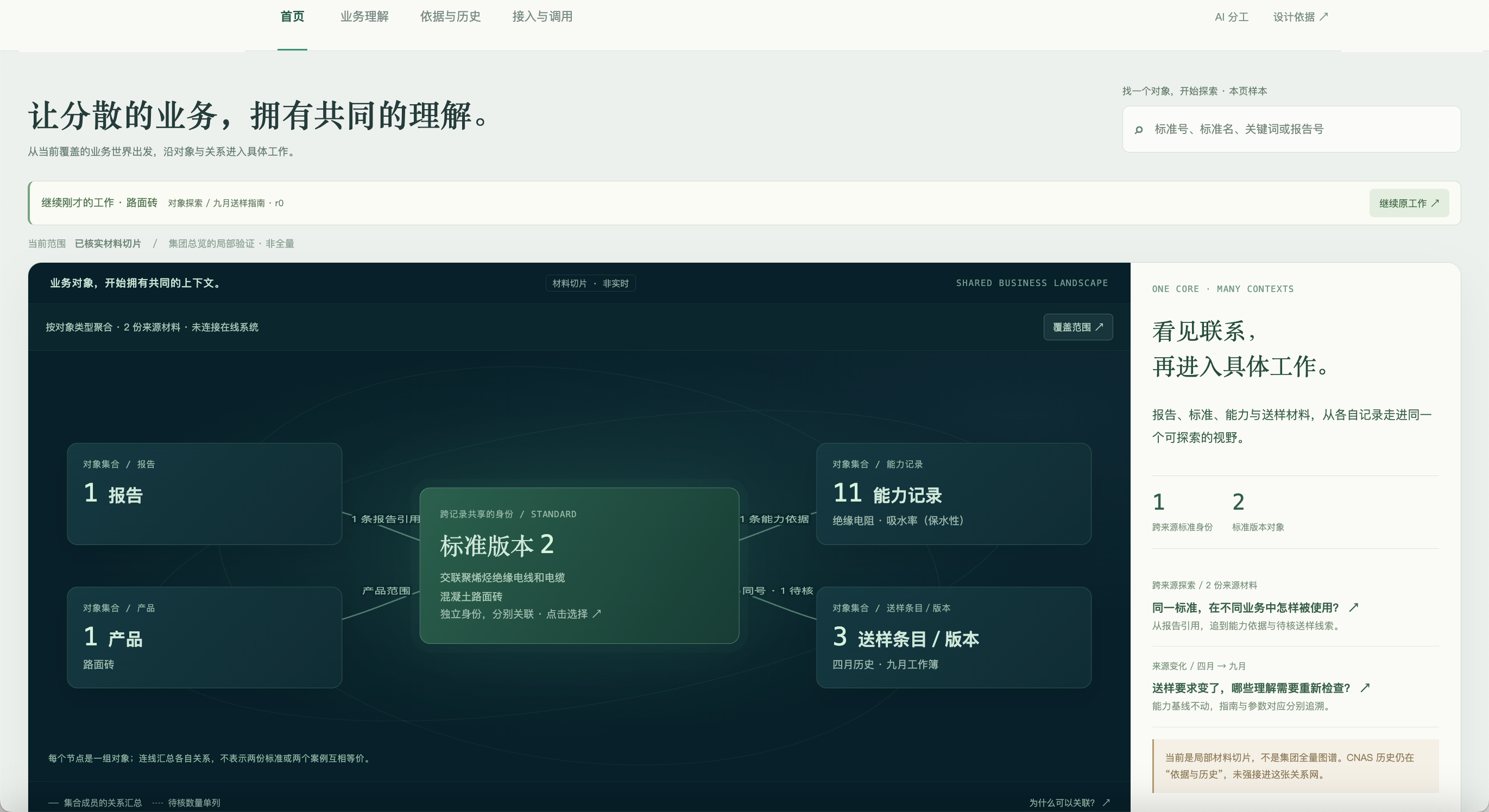
See the connections. Then enter the work.
Reports, standards, capabilities and sampling material share an explorable view. Selecting an object leads into the work. This view covers a limited slice of two source materials.
Original Chinese interface, shown as built. The numbers mark the parts that matter.
- Two standard versions, each a single identity shared across records: one for insulated cables, one for concrete paving blocks.
- The object groups linked to them: a report, a product, 11 capability records and 3 sampling items across versions.
- Resume where you left off: the paving-block task on the September sampling guide, draft r0.
- Start from any object: a standard number or name, a keyword, or a report number.
- Starter questions, for example how one standard is used across different parts of the business.
02 / Explore
 12345
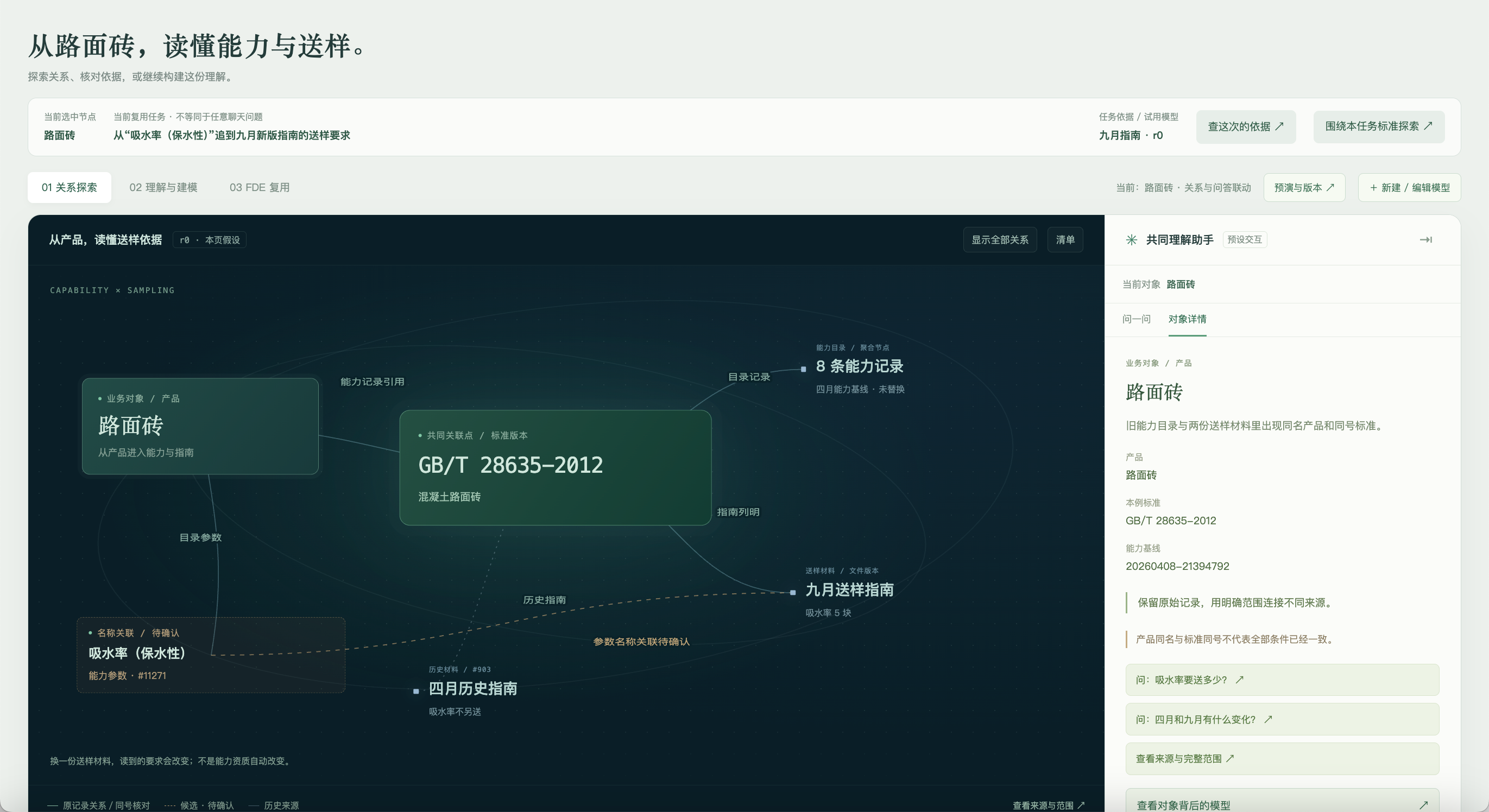
Follow a paving block from capabilities to sampling.
The product and GB/T 28635—2012 connect the capability catalogue with April and September sampling guides. Source wording, version differences and unconfirmed parameter relationships remain visible.
Original Chinese interface, shown as built. The numbers mark the parts that matter.
- The task: trace "water absorption" to the sampling requirement in the new September guide.
- Start from the product: concrete paving blocks.
- The shared node: standard GB/T 28635-2012, which links the product, the capability records and the guides.
- Two sampling guides: September, current, and April, history, drawn dashed. The requirement you read depends on the guide, not on the capability.
- A name link still awaiting confirmation: the parameter "water absorption (water retention)" is shown as a candidate, not assumed.
03 / Model
 12345
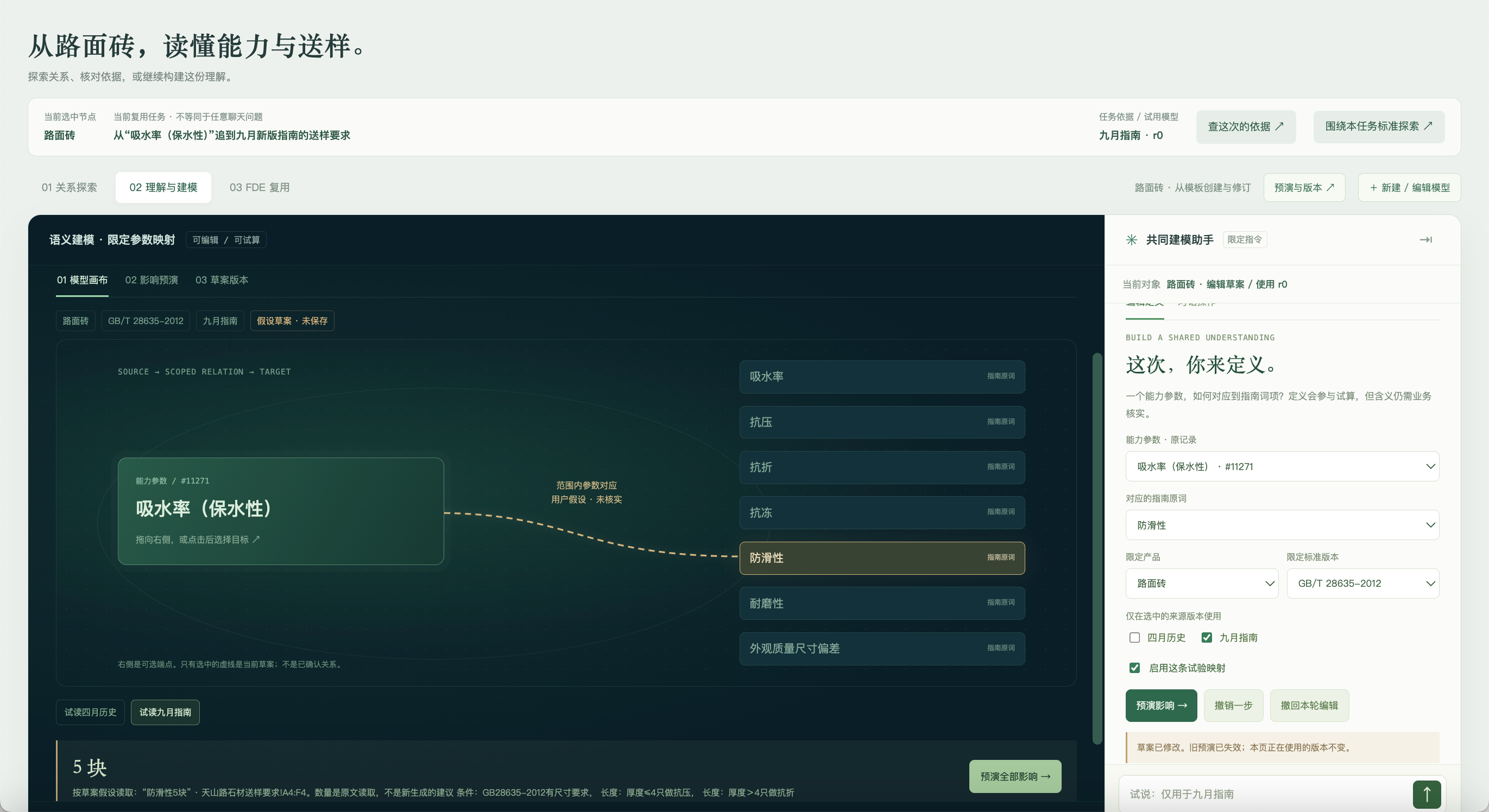
Let people define the relationship and its scope.
A mapping can be edited and scoped to a product, standard and source version before its impact is previewed. The pictured absorption-to-slip-resistance mapping is an unsaved, unverified hypothesis. “5 pieces” comes from the selected guide; it does not establish equivalence between the parameters.
Original Chinese interface, shown as built. The numbers mark the parts that matter.
- The capability parameter from the original record: water absorption (water retention), #11271.
- A mapping drawn by the user and limited in scope: a hypothesis, not verified and not saved.
- The guide term it points to: slip resistance. The other guide terms are listed as candidates.
- What the draft reads from the guide: "5 blocks", quoted from the original text, not generated.
- Preview the impact before anything changes; the version the page uses stays untouched.
04 / Trace sources
 12345
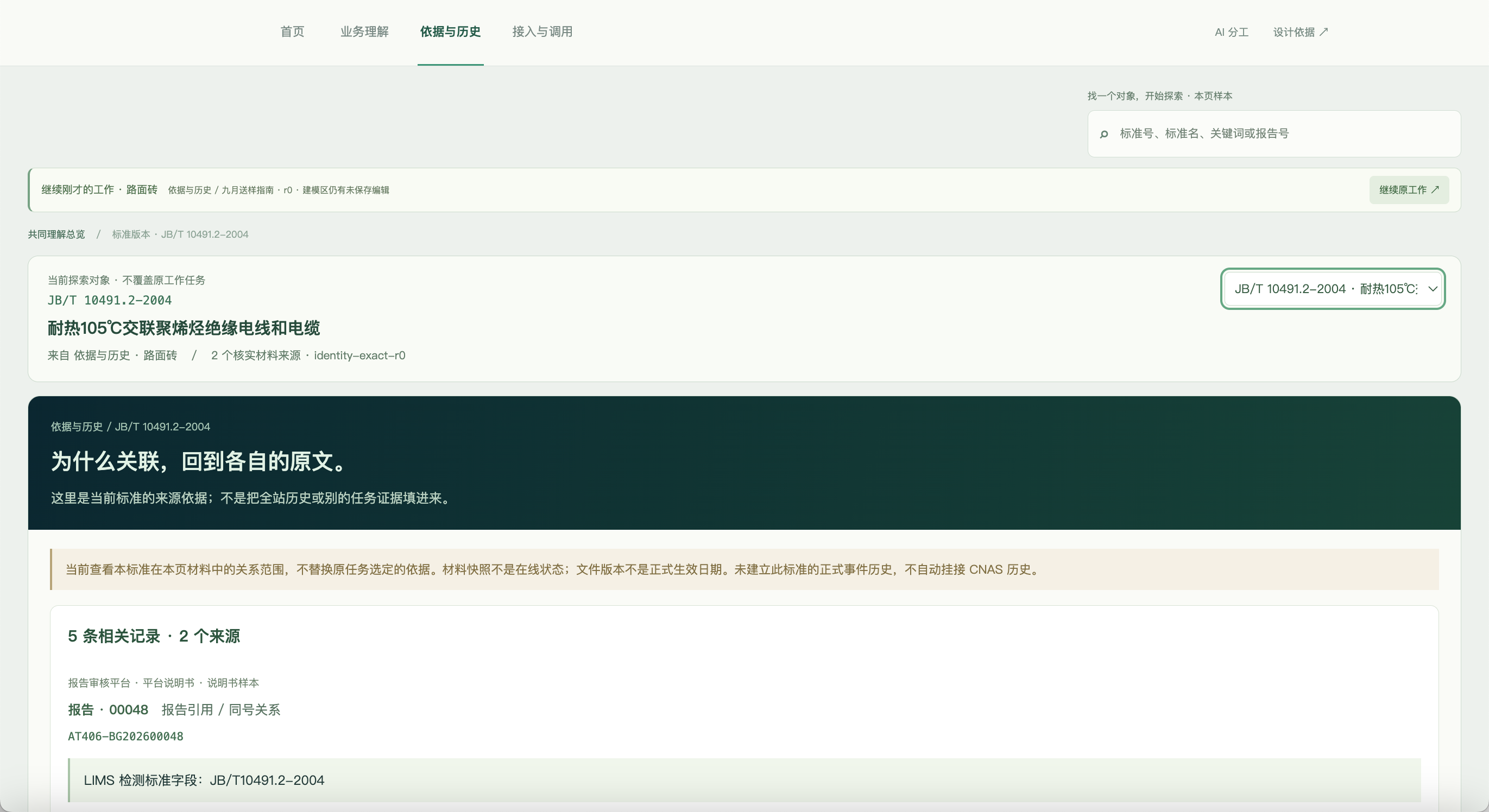
Inspect another source without losing the task.
The open object is cable standard JB/T 10491.2—2004, while the top strip retains the paving-block task and its unsaved draft. Exploration can change without replacing the task’s evidence, model or edits.
Original Chinese interface, shown as built. The numbers mark the parts that matter.
- The object being checked: standard JB/T 10491.2-2004, heat-resistant 105 °C cross-linked polyolefin-insulated wires and cables.
- Where the link comes from: two verified source materials, matched by the identity rule identity-exact-r0.
- Why things are linked: every link goes back to its own source text.
- A scope note: this view does not replace the evidence the task already chose, and it does not pull in CNAS history automatically.
- Five related records from two sources, such as a report that cites the standard and the LIMS test-standard field.
05 / Hand off
 12345
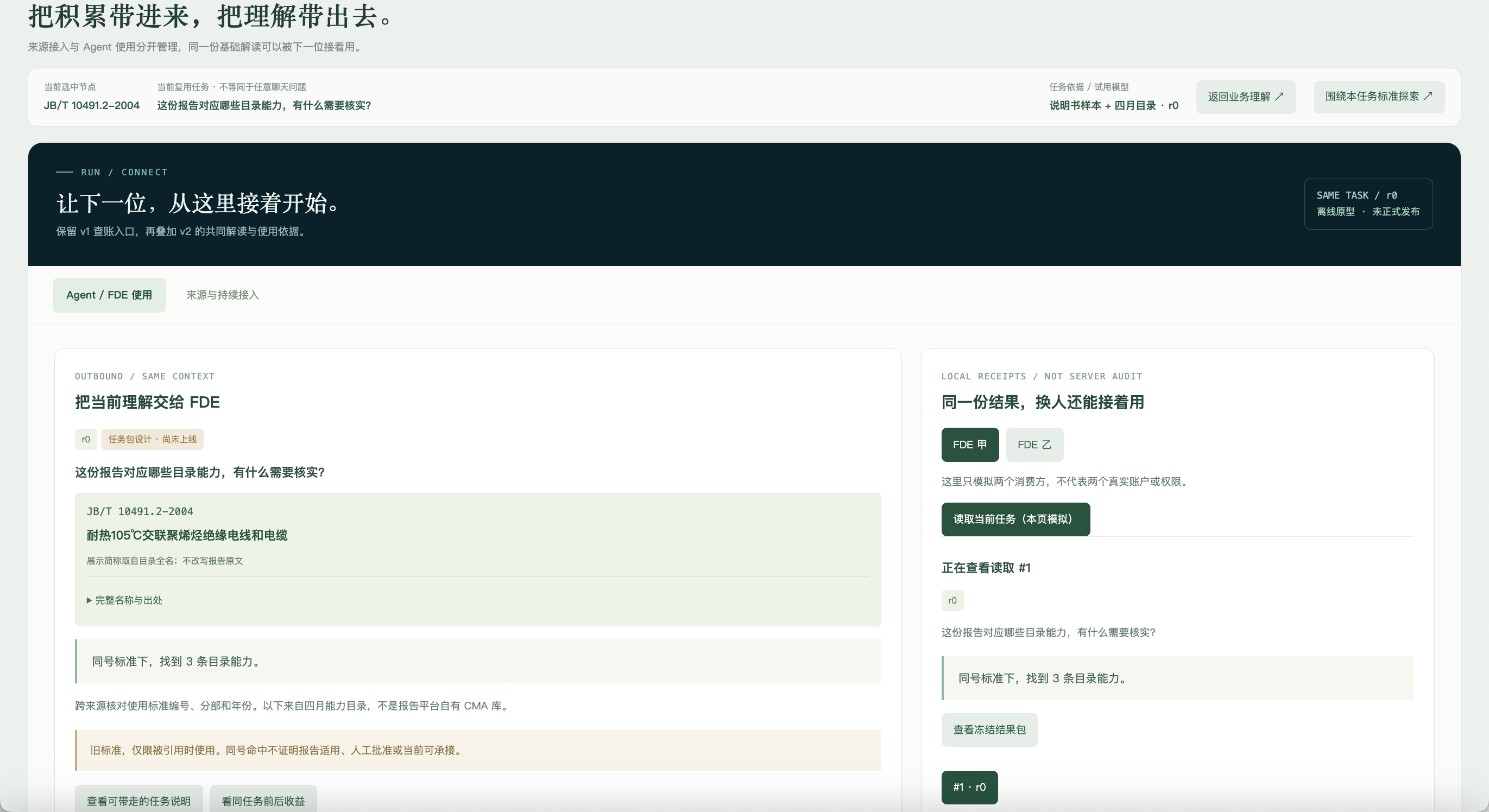
Bring the knowledge in. Carry understanding forward.
This view switches to a report-capability lookup, showing how its question, adopted version and current result travel together. Two simulated FDE consumers read the same result in-page; engineering MCP validation is recorded separately.
Original Chinese interface, shown as built. The numbers mark the parts that matter.
- The reusable task: which catalogued capabilities does this report map to, and what needs checking?
- Hand the current understanding to the next person or agent (FDE); the task package is designed but not yet live.
- The result: three catalogued capabilities found under the same standard number.
- The caveat travels with the result: a same-number match does not prove the report applies, was approved, or can be taken on now.
- Same result, different reader: two simulated consumers read the frozen result r0.
- MY CONTRIBUTION
- Ontology structure, identity rules and governance mechanisms; staged engineering validation; design and conclusions of the OBDA control experiment.
- CURRENT PROGRESS
- Versioning, controlled publishing, read-only MCP, SHACL validation and identity resolution all have isolated validation records (2026-09-17 → 09-25). No ground-truth set; no accuracy claim.
- ON THIS PAGE
- Five prototype captures + five mechanisms + four research findings.
Given a product, a test parameter and a standard version, can the system find the matching sampling rule — and say why?
A competency question, and the first test of whether something is really an ontology. Three layers are kept apart: structure (what objects and relations exist), business semantics (confirmed by people) and runtime governance (every answer traces back to its evidence and version).
Five mechanisms
Each was validated in isolation as a working mechanism. None claims accurate results.
- ONTOLOGY
- OWL as vocabulary only; no reasoning switched on.
Near matches are marked
skos:closeMatchand never auto-merged. Managing the reasoning scope is a lesson from the control experiment (finding 1). - ACCESS
- Controlled read-only MCP with scoped grants and audit.
Three read-only tools, scoped grant/revoke, persistent audit log. Validated: protocol and authorisation. Not yet: real-user trial.
- MORE
- Three further mechanisms cover identity rules, publishing conditions and evidence look-back.
All have been validated in isolation; details are withheld for now.
Four research findings
- Reasoning scope must be managed. One reasoning setting silently turned a count of 340 into 1,585 — no error, just more.
- Identity rules must be validated per source and versioned. The same code-normalisation rule behaves differently across sources; one mapping filter turns 49 into 22.
- Authoritative sources contain errors too. Entry mistakes and an ISBN false merge in the standards library; "authoritative" is not exempt from checking.
- Field meaning must be tested empirically. A field named "upcoming effective date" does not mean what it says.
Figures come from isolated validation records, 2026-09-20 → 09-25. Line-by-line agreement of 13,945 / 13,945 and 998 / 998 means consistency with existing results, not accuracy. R&D trial, not business-reviewed; the ground-truth set and evaluation plan remain proposals.
Current stage
2026.09.25
Mechanisms
Idempotent builds and atomic commits, controlled publishing with bounded self-checks, read-only MCP with audit, SHACL validation, identity resolution — each with a dated record.
Virtual vs copy
Ontop OBDA takes the virtual route (ontology + mappings → live SQL); the main line takes copy + version + evidence. The trade-off is written up for later selection.
Ground truth and business review
Only one domain class (Standard) so far, the rest are governance classes; no ground-truth set; MCP untested by real users. Until these close, no accuracy figure can be stated.
Keep "why it decided so" before asking "how accurate".
The value of an ontology is not one more graph layer; it is that every answer traces back to its evidence, its version and the person who confirmed it. Once that layer stands, models and agents can change without re-learning the business.
My contribution, collaboration and evidence
My contribution
I frame the product, design the relationship between objects and tasks, define human involvement and sequence engineering validation. Implementation uses coding-agent assistance and builds on the existing platform and authorized industry material.
Evidence
The five captures are from the 17 September interaction prototype, with browser chrome and identifiers removed. Mechanisms and figures come from isolated validation records of 17–25 September; they validate that mechanisms work, not that results are accurate. No claim of production launch or quantified business benefit; no internal system names, customers or data volumes.